
Tulip Care Checklist: What to Do Each Month from Planting to Dormancy
A month-by-month guide to tulip care, from choosing and planting bulbs in autumn through spring feeding...

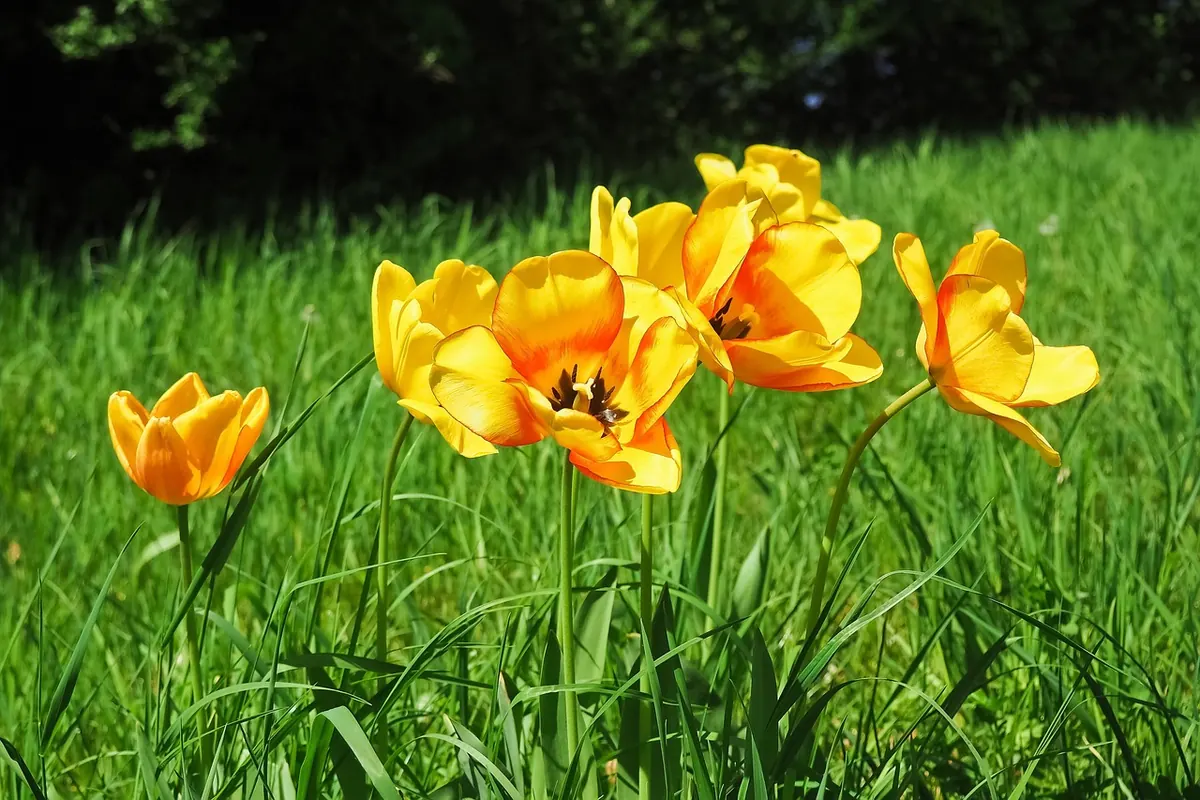
Tulips in grass have a reputation for being difficult, and for once it is half deserved. Tip a packet of tall Darwin hybrids onto a mown lawn and most will sulk, split into leaves and disappear within two springs. Choose the right bulbs, plant them properly in late autumn, and a rough corner of grass will colour up every April with almost no input from you. Here is how to get it right first time.
Tulips run on a cycle that lawns already provide: a cool, damp spring while they grow and flower, then a baking summer dormancy while the bulbs sit underground doing nothing at all. In a border that dormant season is hard to deliver. You water the bed for the dahlias, the soil stays moist, and the bulbs rot. Out in a meadow patch on free-draining ground, the grass dries out in July and the tulips get exactly what they evolved for.
It is worth remembering where tulips come from. They are not woodland plants and they are not cottage-garden plants. They come from the mountains and steppes of Central Asia, Turkey and Iran, where winter is cold and wet, spring is brief and bright, and summer is a scorching drought. A meadow that is wet until June and bone-dry until October is the closest thing most of us can offer to that original home.
There is a second, more practical advantage that gardeners rarely mention: grass hides the dying foliage. A tulip has to keep its leaves for six weeks after flowering to feed the bulb for next year, and those leaves go yellow, flop and look dreadful. In a border you are left staring at them and tempted to cut them off too early — which is precisely how people end up with a one-season display. In grass, the yellowing foliage is threaded among green blades and simply reads as part of the scene.
Add to that the fact that a thick stand of grass holds the stems upright in wind, insulates the bulbs against hard frost, and stops weeds germinating, and the case for the meadow approach starts to look less like a compromise and more like common sense.
This is the single biggest factor in success, and it has nothing to do with technique. Most tulips sold in garden centres are bred for the cut-flower trade: they are grown in Dutch fields for one glorious season, lifted, sold, and never expected to come back. Plant those in grass and they will give you one reasonable April and then fade.
What you want instead are species tulips and a small number of heritage varieties — plants that are genetically inclined to set seed, split offsets and spread.
Planting time matters almost as much as variety. Aim for late October through November, once the soil has cooled but before it freezes. Bulbs planted in early September may still be warm enough to start into growth prematurely, and autumn-rooted bulbs that then sit through a wet December can rot.
Depth matters more than most guides admit. In a border you would plant a tulip two or three times its own height. In grass, go deeper: 15 to 20 centimetres below the surface, or roughly three to four times the bulb's height plus a little. Deep planting keeps the bulb cool and moist through spring, holds it steady so it does not split into a cluster of small non-flowering bulbs, protects it from a mower blade, and — crucially — puts it below the layer of soil that dries out fastest in summer, so it can finish ripening without baking to dust.
Tulips in grass fail for one reason more often than all others combined: wet summer soil. If your lawn sits on heavy clay and stays damp in August, no amount of careful planting will save the bulbs. Choose the sunniest, highest, most free-draining corner you have — a slope is ideal, a south-facing bank better still. If the whole garden is clay, either raise the planting area into a shallow mound, or stick to Tulipa sprengeri and Tulipa sylvestris, which are the most tolerant of the lot, and accept that you are pushing your luck.
Everything above is preparation. This is the part that decides whether your tulips come back.
Do not cut the grass until at least six weeks after the last flower has dropped its petals. During that period the leaves are photosynthesising and pumping energy back into the bulb for next spring. Cut them off early and you have, in effect, stolen the bulb's entire savings account. The plant will not die, but it will come back smaller, flower less, and eventually give up.
That means no mowing from roughly the beginning of March until mid-June in most of Britain — sometimes July. It is a real commitment, and if you are not prepared to make it, plant your tulips in pots instead.
Plant them deep, forget them entirely, and cut the grass late. Almost every tulip that fails in grass was killed by a lawnmower in May.
Naturalising is as much a design decision as a horticultural one. Nature does not plant in straight lines or neat grids, and neither should you. Take a handful of bulbs and scatter them, then plant each one exactly where it lands — that randomness is what makes a meadow read as a meadow.
Work in groups of at least fifteen or twenty bulbs of the same variety, and give each group an irregular, blurred edge. A single tulip standing alone in a lawn looks like an accident. Twenty of them in a soft-edged pool look like they have always been there. If you are planting several varieties, keep them in separate patches rather than mixing them up, so each one can be allowed to spread without muddying the effect.
Tulips are only one act in a longer play. Other bulbs that thrive under the same wet-spring, dry-summer regime will give you colour from February to June and make the whole patch look intentional rather than accidental.
Gardeners in the Netherlands and northern Germany have a word for this whole tradition: stinzenplanten, the plants that naturalise around old country estates. The recipe has not changed in three hundred years — damp spring ground, dry summer ground, and a mower that stays put until the foliage has finished its work.
Almost always bulbs planted too shallow and split into a cluster of small offsets, or bulbs that were cut down too early last year. Dig one up in summer and look: if you find a nest of tiny bulbs where there should be one fat one, plant deeper next time.
Either the variety is a non-returning modern hybrid, or the summer soil is staying wet. Check both.
Mice, voles and squirrels. Deep planting helps a little; so does planting among Narcissus, whose bulbs rodents dislike. You can also lay a sheet of fine mesh over the planting area.
Tulip fire, a fungal disease encouraged by damp, crowded conditions and repeat planting in the same spot. Lift and destroy affected bulbs and do not replant tulips in that patch for several years.
The first spring after planting will look thin. Species tulips are small, and one bulb makes one flower. The second year is better. By the third or fourth year the offsets and self-sown seedlings start to fill in, and the patch begins to look as though nobody planted it at all — which is the entire point.
After five or six years, flowering may start to decline as the clumps become congested. Lift a patch in late summer, tease the bulbs apart, replant the largest at the correct depth, and start the clock again. Beyond that, the work involved in a naturalised tulip meadow is roughly one decision a year: do not mow yet. Get that right, and the rest takes care of itself.
Photo: 652234 / Pixabay
A month-by-month guide to tulip care, from choosing and planting bulbs in autumn through spring feeding...
How to combine tulips and wallflowers in a UK spring border, covering colour schemes, height layers,...
Cut tulips at the right stage, condition the stems properly and keep the water shallow, and a spring bunch...