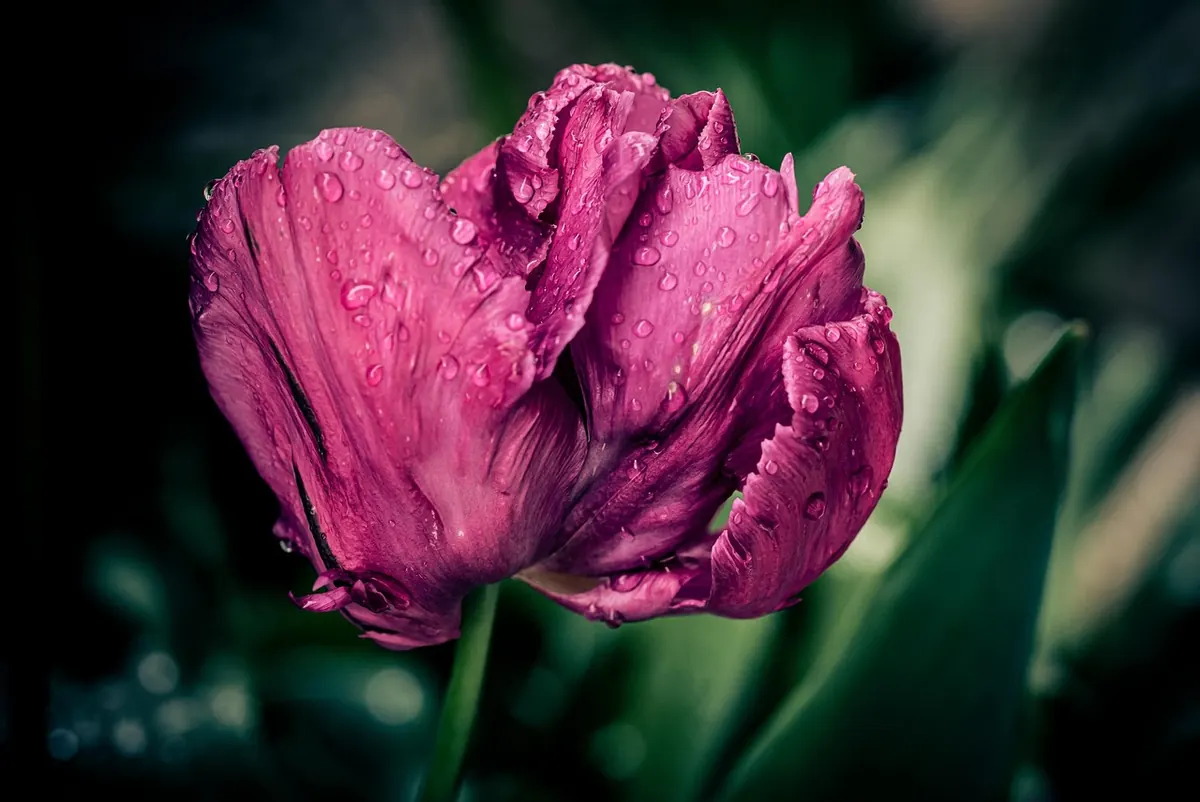
Tulip Care Checklist: What to Do Each Month from Planting to Dormancy
A month-by-month guide to tulip care, from choosing and planting bulbs in autumn through spring feeding...

Tulips are just about the only cut flower most of us grow that carries on growing after it leaves the garden. Stems stretch, buds lean towards the window, and a bunch that looked neat on Sunday can be draped over the rim of the vase by Wednesday. That is not a failure of your arranging. It is simply how tulips behave.
Get two things right — the moment you cut and the first few hours afterwards — and the rest is mostly habit.
Timing matters more with tulips than with almost anything else you will cut. A bud that has already opened out in the garden has spent its best days outdoors, and a bud cut too green may never open at all once it is indoors.
Aim for the stage where the bud is fully coloured but still closed and tight, with the petals folded and no sign of them parting. Early morning is ideal, while stems are full of water and the day is still cool. Early evening on a warm day is the next best thing. Try to avoid cutting in the middle of a hot afternoon, when stems are soft and lose water fast.
If you are cutting from a border rather than a cutting patch, you can be more relaxed. Take the flower when it suits the display, but remember that anything you cut is one less bloom outside.
Use sharp secateurs or a sharp knife. Blunt blades crush the stem, and bruised tissue rots in the vase; a clean cut lets water move straight up to the flower.
Cut on a slant, taking two or three centimetres from the base, and cut longer than you need — you will trim again before arranging. If the tulips are growing in the ground and you want the bulbs to come back strongly next spring, cut above the lowest pair of leaves and leave the foliage to die back naturally for about six weeks. Those leaves are feeding the bulb.
Take a bucket of cool water into the garden with you and stand the stems in it as you cut, upright and out of the sun. Every minute a stem spends dry is a minute it spends closing the fine channels that carry water to the flower.
Conditioning is the step most people skip, and it makes the biggest difference. It simply means giving cut stems a quiet period in cool water before they go anywhere near the arrangement.
Two tulip-specific warnings. First, keep them away from daffodils. The sap narcissi release into the water damages other flowers, so condition daffodils separately for at least a day before mixing them. Second, tulips — and especially the bulbs — are toxic to cats, dogs and small children, so keep vases out of reach.
Tulips last best in a cool room, out of direct sunlight and away from radiators, woodburners and other sources of dry heat. A hallway or a north-facing windowsill will do more for vase life than any additive.
Keep them away from the fruit bowl, too. Ripening fruit gives off ethylene gas, which speeds up ageing in flowers.
Change the water daily if you can, and every second day at the very least. Recut the stems by a centimetre or so each time, and pick off any leaves that have started to yellow.
Tulips are the least obedient flowers in the vase and the most rewarding once you stop fighting them. They will grow an inch or two taller and lean towards the light, so a tight, formal arrangement will not stay formal for long. Plan for movement instead.
Because tulips keep growing, the arrangement will shift over the week. That is part of the pleasure. Turn the vase now and then so the stems lean evenly rather than all flopping in one direction.
If the stems have gone limp but the flowers still look fresh, they are usually salvageable. Trim two or three centimetres from the base, wrap the whole bunch firmly in newspaper — snug, but not tight enough to bruise — and stand it in cool water in a cool, dark place for three or four hours, or overnight. The wrap holds the stems straight while they take up water, and most bunches stiffen noticeably.
Once a stem has folded sharply just below the flower head, that stem is finished. Cut it short and float the bloom in a shallow bowl of water, which is a lovely use for the last few tulips of the season.
Cut in the cool of the day at the coloured-bud stage, get the stems straight into water, condition them in a cool dark place, then display them in shallow water away from heat, sun and fruit. Change the water, recut the stems and remove tired leaves every day or two, and expect a good week or more from a decent bunch.
Tulips are fleeting by nature, and generous with it. Cut them well and they will keep opening, stretching and rearranging themselves on the windowsill — which is more than most cut flowers ever manage.
Photo: congerdesign / Pixabay
A month-by-month guide to tulip care, from choosing and planting bulbs in autumn through spring feeding...
How to combine tulips and wallflowers in a UK spring border, covering colour schemes, height layers,...
A practical guide to keeping tulips healthy through a wet UK spring: improving drainage, spotting rot...